What must the label say?
Find the nutritional adequacy statement on the back of the bag — the same line our dog food buying guide treats as the most important on any label. For a puppy it must say the food is formulated (or feeding-trial tested) for "growth" or "all life stages" under AAFCO or FEDIAF standards. "Adult maintenance" food is not enough for a puppy: growth demands more protein, more calories, and precisely controlled minerals than maintenance formulas carry.
Then apply the manufacturer test: does the company employ veterinary nutritionists, run its own quality control, and answer questions about nutrient analysis? Those signals separate well-made food from well-marketed food at every price point.
Why do large-breed puppies need a special formula?
This is the one place where getting puppy food wrong causes permanent harm. Puppies expected to exceed roughly 25 kg as adults — Labradors, Goldens, German Shepherds, and up — must eat a large-breed growth formula. The reason is calcium: large-breed puppies absorb calcium inefficiently in their regulation and grow so fast that excess calcium and excess calories both push the skeleton toward developmental orthopaedic disease — hip and elbow dysplasia, osteochondrosis — conditions that surgery manages but nothing cures.
Large-breed growth formulas control calcium levels and calorie density so the puppy grows to the same final size, just more slowly and on straighter joints. Two corollaries: never add calcium supplements to a growing puppy's diet (the food is already balanced for it), and keep large-breed puppies lean — a slightly slim puppy is a healthier puppy. The AAFCO statement will say the food is suitable for growth "including growth of large size dogs (70 lb or more as an adult)" — that exact phrase is what you are looking for.
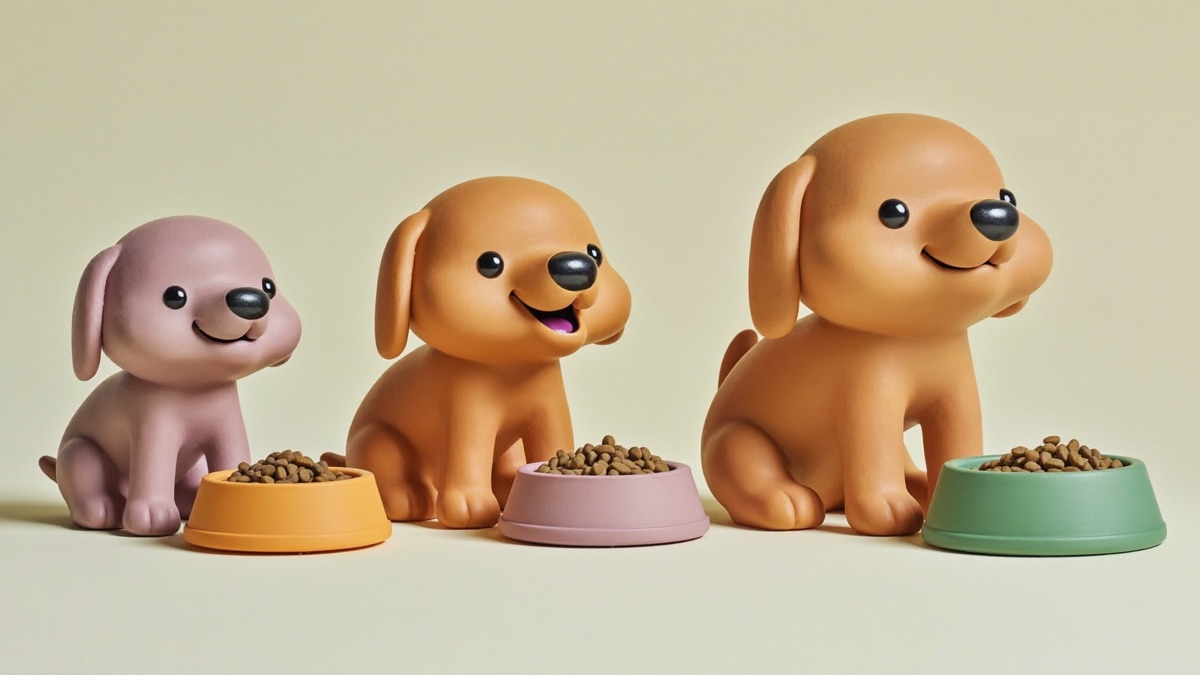
What about small and toy breeds?
Small breeds have the opposite problems: tiny jaws and tiny stomachs. Choose a small-breed puppy formula for the physically smaller kibble — a toy poodle facing large-breed kibble may simply not manage it — and for the higher calorie density that suits a stomach the size of a walnut. Toy-breed puppies (Chihuahuas, toy poodles, Malteses) can develop low blood sugar if meals are missed, which is one reason frequent small meals matter so much in the first months.
How often should a puppy eat?
| Age | Meals per day |
|---|---|
| 6–12 weeks | 3–4 |
| 3–6 months | 3 |
| 6–12 months | 2 |
| Adult | 2 |
Measure the daily amount with a scale or the same scoop, split it across the meals, and adjust by body condition — you should feel ribs easily under a light fat cover. Feeding guides on the bag are starting points, not prescriptions. Meal times slot naturally into the eat-play-toilet-sleep rhythm covered in our puppy schedule guide.
One rule that outranks all of this in week one: feed whatever the breeder or shelter was feeding for the first two weeks. A new home is a major stress, and stacking a diet change on top is the classic recipe for puppy diarrhoea. Once the puppy has settled and stools are consistently normal, move to your chosen food gradually over 7 days — our food switching guide has the exact schedule.

When should I switch to adult food?
When growth is essentially complete — and that depends on adult size:
Scroll sideways to compare all columns →
| Adult size | Examples | Switch to adult food at |
|---|---|---|
| Toy/small (under 10 kg) | Chihuahua, toy poodle, Shih Tzu | 10–12 months |
| Medium (10–25 kg) | Beagle, Border Collie, Corgi | ~12 months |
| Large (25–40 kg) | Labrador, Golden Retriever, GSD | 12–18 months |
| Giant (over 40 kg) | Great Dane, Mastiff types | 18–24 months |
Switching too early deprives a still-growing dog of growth nutrition; staying on calorie-dense puppy food too long mostly just feeds fat onto a finished frame. If in doubt, your vet can judge growth plates and body condition at the annual vaccination visit. As of 2026, budget roughly S$40–90 / RM120–300 per month to feed a small-to-medium puppy good complete kibble in Singapore or Malaysia — and remember the most expensive bag on the shelf buys marketing as often as it buys nutrition. Criteria first, brand last.