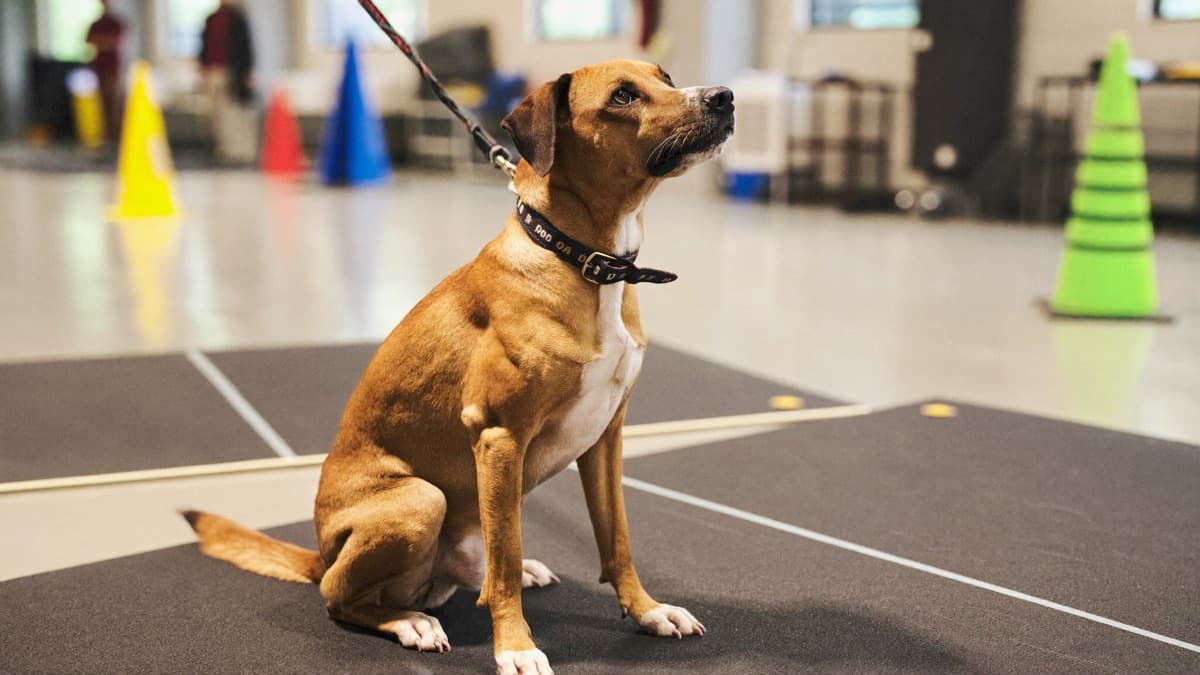
Group class, private trainer or board-and-train?
Use this decision guide when discussing suitability with a trainer:
Scroll sideways to compare all columns →
| Format | What to discuss | Before booking |
|---|---|---|
| Group class | Practising everyday skills around other dogs and people | Ask how dogs are screened, how much space each gets and what happens if your dog becomes overwhelmed. |
| Private sessions | Coaching in your home or another agreed setting | Describe the problem and ask whether it needs a behaviour specialist or veterinary assessment. |
| Board-and-train | Residential care combined with training | Ask to see the facilities, methods, daily care arrangements and owner handover plan. Get the boarding and training terms in writing. |
These are questions for choosing a service, not promises that one format suits every dog. A programme should explain what you will practise between lessons and how progress will be assessed.
For serious behaviour concerns, start with your vet to check possible medical contributors and arrange appropriate help. Obedience cues alone do not resolve every underlying fear or anxiety. AVS explains the distinction between training and behaviour modification.
How do I check ACDT accreditation?
Open the current AVS trainer list and search for the person who will teach you. It lists individuals, their qualifications and associated businesses. Certifications must remain valid. Ask who covers absences and whether that person has the qualification you require.
A listing is a useful credential check, not a substitute for discussing methods, suitability or a particular course. Do not assume every employee of a listed person's business has the same accreditation.
Is accredited training compulsory?
AVS requires basic obedience training for specified breeds, dogs assessed by AVS as aggressive or potentially dangerous, and Project ADORE dogs. Project ADORE training may also be conducted by ADORE dog trainers. The AVS page gives the certificate submission deadline and process. Confirm the appropriate trainer and certificate before paying for a course intended to meet a requirement. Basic obedience is not mandatory for every dog.
What methods should I look for?
The AVSAB humane-training statement recommends reward-based training and advises against methods involving pain, intimidation or fear. Ask concrete questions:
- What happens when my dog does not respond?
- Which rewards and equipment will you use?
- Can my dog move away or take a break?
- How will you change the exercise if my dog is frightened?
- Can I observe a session or see an example of your teaching?
Avoid choosing solely on reviews, a fast-results promise or a label such as “balanced”. Ask what the words mean in practice. For any advertised guarantee, read whether it offers extra lessons, a refund or something else, and what conditions apply.
What will a course cost?
As checked on 24 September 2026, Pawsitive Furkids advertises seven one-hour group lessons for S$650; Waggie advertises eight roughly 90-minute group lessons for S$880. Those work out at about S$92.86 and S$110 per lesson respectively, but their lesson lengths differ.
For private lessons, puppy programmes and behaviour packages, use the provider price tables. Confirm the final fee, availability, missed-class policy and any equipment or travel charges with the provider.
When can a puppy start?
Early positive experiences matter. The AVSAB puppy-socialisation statement says suitable classes can begin as early as seven to eight weeks, with at least one vaccine set given seven days beforehand and initial deworming. This is general professional guidance, not automatic clearance for your puppy or every class.
Ask your vet about local infection risk and your puppy's health, then check the provider's admission rules. Continue positive experiences as your dog grows; there is no reason to abandon training because a puppy is older. Our puppy socialisation guide explains how to plan manageable experiences in Malaysia and Singapore.