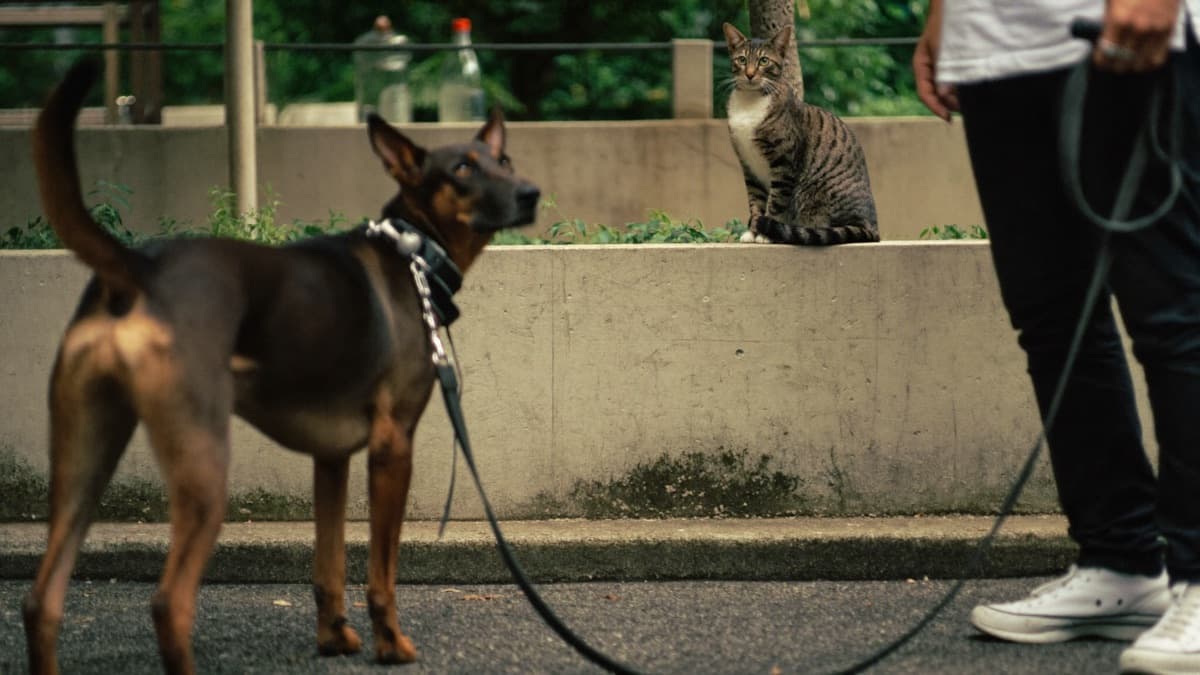
Is my dog playing or hunting?
Honesty first: chasing a cat sits on the front end of the predatory sequence that's wired into every dog — eye, stalk, chase, grab-bite, kill-bite. Selective breeding turned the full sequence down or off in most pets, but the front segments survive intact in many dogs, and they feel intensely rewarding to perform. That's why chasing is self-reinforcing: the chase itself is the payoff, no catch required.
The two kinds of chasing look different before they look similar:
- Play chase is loose, bouncy and noisy. The dog's body is curved, there are play bows and pauses, roles may swap, and the dog responds — even slightly — to your voice and to the cat's "enough" signals.
- Predatory chase starts silent and stiff. Hard fixed stare (eye), head and body lowered into a creep (stalk), then an explosive, straight-line sprint (chase) during which your voice may as well not exist.
A dog that stalks before it sprints, or that grabs when it reaches the cat, is running predatory sequence — and no amount of "they're just playing" wishful thinking changes what happens if it ever connects. Judge the behaviour by its shape, not by how friendly your dog is with people.
Why does management come first — always?
Because training can fail, and the cost of failure here is not negotiable. Every serious behaviour plan for cat chasing starts with the same unglamorous layer:
- Physical separation at home: baby gates the cat can pass and the dog can't, cat-only rooms, vertical escape routes (shelves, cat trees) in every shared space, and a closed door between them whenever nobody is actively supervising. Not "usually" — always.
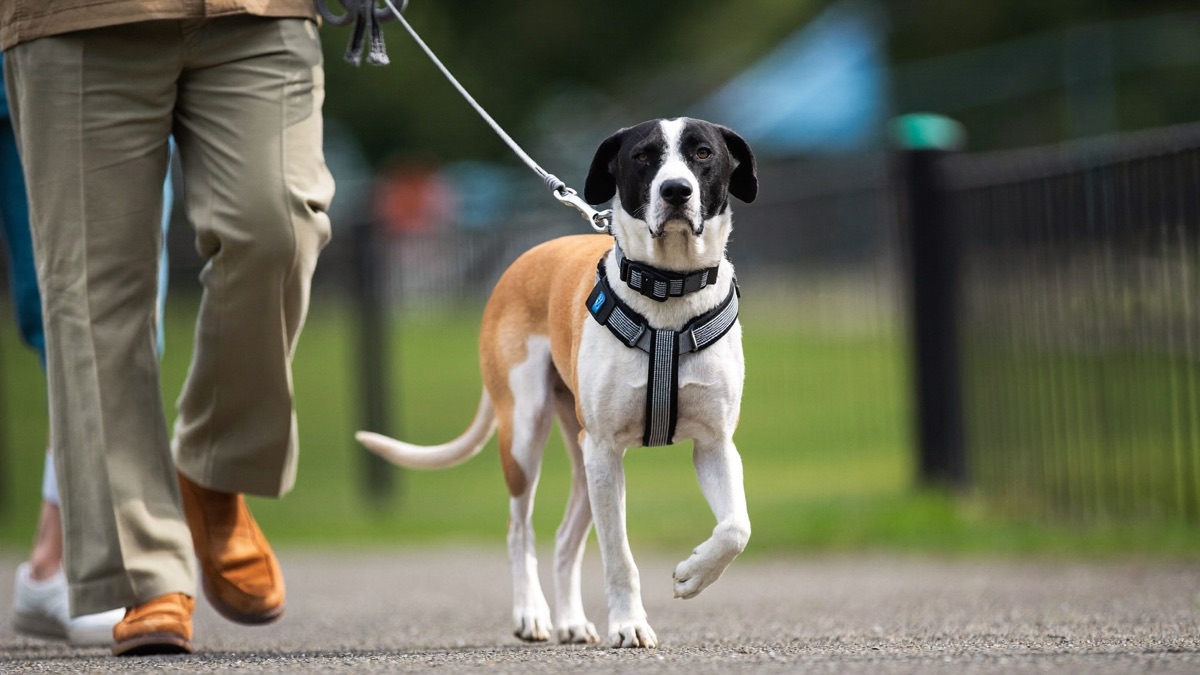
- Leash or long line any time the dog is somewhere cats appear. Outdoors in Singapore this is the law anyway; at home during introductions it's a house rule.
- No rehearsal. Every successful chase is a jackpot that strengthens the circuit. A dog that hasn't chased in six months is a dog whose habit is fading; one good corridor sprint resets the clock.
Management isn't the admission that training failed — it's the floor that makes training possible and keeps the cat alive while it happens.
What is engage-disengage training?
The goal is not a dog that never notices cats — that dog doesn't exist. The goal is a dog that notices a cat and looks at you. Engage-disengage builds exactly that, at whatever distance your dog can still think:
- Find cat-distance. Set up far enough from a (safe, unreachable) cat that your dog can see it but still eat, respond to its name and keep its body loose. For some dogs that's five metres; for others it's fifty. Too close and no learning happens.
- Mark the look (engage). The instant your dog notices the cat — before the stare hardens — mark ("yes!" or a clicker) and feed. You're paying for calm noticing.
- Wait for the look-away (disengage). After a few repetitions, hold the mark. Most dogs glance at the cat, then check back at you as if to ask where the treat went. Mark that — the voluntary look-away — and pay generously. This is the behaviour you're actually building.
- Shrink the distance slowly, over weeks, only while the dog stays loose and responsive. Stalking posture, freezing or ignoring food means you're too close: add distance and continue.
This is standard desensitisation and counterconditioning wearing work clothes — the same engine as our guide to desensitisation and counterconditioning, pointed at cats.

What about Singapore's community cats?
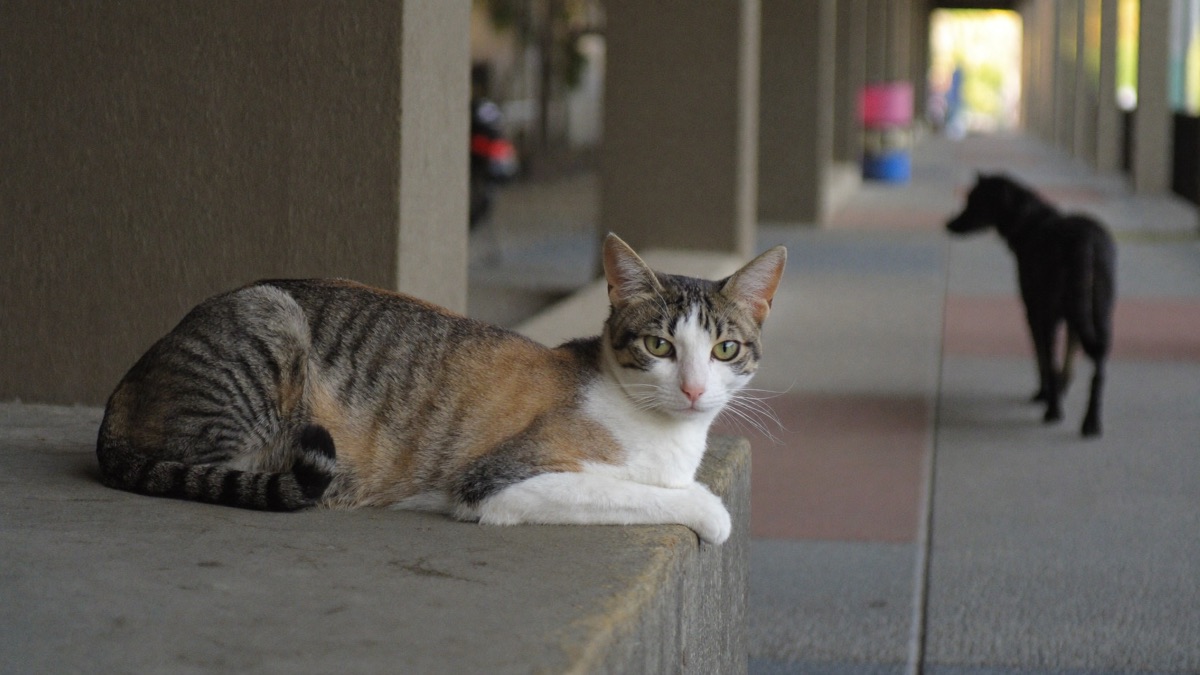
Void decks, carparks and corridor ledges come with resident cats, and your dog will meet them on every walk. Two realities frame this. First, the law: dogs in Singapore must be leashed at all times in public — designated dog runs are the only exception — so "he slipped off to say hello" is a breach before it's anything else. Second, respect: community cats are cared for by feeders and neighbours, are part of the estate, and owners are responsible for what their dogs do to them.
Practically, the void deck is your free training ground: community cats are habituated, predictable and usually settled on ledges — near-perfect engage-disengage props at a distance you control. Cross to the far side, run your reps, and keep walking. Never let your dog strain towards, corner or "greet" a community cat, and shorten the leash before lift lobbies and bin centres, where cats appear at close range without warning.
Can strong prey drive ever be fixed?
Managed, yes — reliably and for life. Erased, rarely. A dog with genuine predatory drive towards cats can learn excellent behaviour around cats: calm on leash, responsive at realistic distances, even relaxed cohabitation with a specific known cat. What training doesn't do is delete the wiring, and breed genetics set the ceiling — spitz breeds and sighthounds, among others, carry famously intact chase circuitry, something our Husky guide is blunt about.
So the honest promise is this: with airtight management and patient engage-disengage work, most dogs and cats can share a home or a neighbourhood safely. But the gates stay up, the leash stays on, and the unsupervised-together milestone is earned in years of indifference, or never. That's not failure — that's what responsible ownership of a predator-shaped pet looks like.